
Table of Contents
If you’re looking into an IPTV Reseller 20 Credits package, you’re probably trying to answer one deceptively simple question: Is 20 credits enough to start, and are you actually getting good value for your money?
The answer depends on much more than the number printed on a pricing page. One provider’s 20 credits may represent something very different from another provider’s 20 credits. Subscription length, customer activations, dashboard features, support, renewal terms, device compatibility, and—most importantly—authorization to distribute the underlying programming can all change the real value of a package.
For you as a prospective reseller, that makes comparison essential. A low advertised price can look attractive until you discover that credits expire, renewal costs are much higher, customer management tools are limited, or the provider cannot demonstrate that it has the rights necessary to distribute the content it offers. On the other hand, a slightly more expensive package can be considerably more useful if it provides transparent terms, dependable infrastructure, responsive support, and a legitimate licensing arrangement.
This guide walks you through what an IPTV Reseller 20 Credits package generally means, how to evaluate pricing, which features deserve your attention, how to calculate potential economics, and what questions you should ask before committing your money.
Most importantly, you’ll learn how to distinguish a genuinely useful reseller package from one that simply looks inexpensive at first glance.
What Is an IPTV Reseller 20 Credits Package?
An IPTV Reseller 20 Credits package is generally a small reseller allocation containing 20 units of credit that you can use according to the provider’s particular subscription, activation, or customer-management rules. The terminology is not standardized across the industry, so you should never assume that one credit automatically equals one customer, one month, or one particular service tier.
That’s the first important lesson when you’re comparing packages. The word “credit” sounds precise, but it isn’t necessarily a universal measurement. One provider might allow a credit to activate a customer subscription for a defined period, while another might use credits for different subscription durations or account types. Some providers may also impose separate rules for renewals, upgrades, replacements, or expired credits.
Before you compare an IPTV reseller 20 credits price with another offer, therefore, identify exactly what the 20 credits purchase. You want the provider to explain the relationship between a credit and the service you’re authorized to sell. If the explanation is vague, that’s a warning sign rather than a minor inconvenience.
What Are IPTV Reseller Credits?
Reseller credits are essentially a unit of commercial allocation used by some IPTV or digital-service providers to organize reseller accounts. Instead of charging you separately for every customer transaction, the provider may sell you a block of credits that can then be assigned according to its reseller rules.
For example, a legitimate provider might define one credit as a specific customer subscription period. You could purchase 20 credits, use those credits for 20 qualifying activations, and then purchase additional credits as your customer base grows. Another provider could define its credit system differently, perhaps with different credit requirements for different subscription periods.
The important point is that 20 credits does not have an industry-wide meaning.
When you evaluate a package, ask for the answer to these questions in writing:
- What does one credit purchase?
- How long does the resulting subscription last?
- Does one customer consume one credit?
- Do renewals require additional credits?
- Do credits expire?
- Can unused credits be carried forward?
- Can credits be transferred?
- Are credits refundable?
- Are different subscription tiers priced differently?
- Are there separate setup or management fees?
These details give you a much more accurate picture of the package than the headline number.
How Does a 20-Credit IPTV Reseller Package Work?
The basic concept is usually straightforward. You establish a reseller relationship with a provider, purchase a defined number of credits, and then use those credits according to the provider’s documented rules.
A typical process might look like this:
- Review the provider’s reseller terms.
- Confirm that the provider is authorized to distribute the content or services you’re planning to resell.
- Purchase a 20-credit allocation.
- Access the authorized reseller dashboard, if one is provided.
- Use credits for qualifying customer activations.
- Monitor your remaining balance.
- Handle renewals according to the provider’s rules.
- Purchase additional credits only when your legitimate customer demand justifies expansion.
The exact workflow varies, so don’t build your business around assumptions based on another provider’s dashboard.
Your objective should be to understand the entire customer lifecycle before buying: activation, account management, renewal, cancellation, technical support, refunds, and eventual scaling.
Are 20 Credits Enough for a New IPTV Reseller?
For a new reseller operating with a legitimate provider, 20 credits can be a sensible test allocation if the terms are clear and the upfront cost is manageable. A smaller package limits your initial financial exposure and gives you an opportunity to understand the platform before committing to a larger allocation.
You can use a small package to evaluate practical questions such as:
- How easy is the reseller dashboard to use?
- How quickly does support respond?
- What happens when customers encounter technical problems?
- How predictable are renewals?
- How much administrative work does each customer create?
- Does the provider communicate maintenance clearly?
- Are the advertised features actually available?
- Can you scale if demand becomes consistent?
Starting smaller can be particularly useful when you have not yet established customer demand. You don’t want to purchase a large inventory of credits simply because the larger package offers a lower nominal price per credit.
At the same time, 20 credits may be too restrictive for an established operation. If you already have a predictable customer base, a larger allocation could offer better economics or reduce the frequency with which you need to replenish your account.
The right starting point is therefore determined by your expected demand and the provider’s actual credit rules, not by the number 20 alone.
IPTV Reseller 20 Credits Pricing: What Should You Expect?
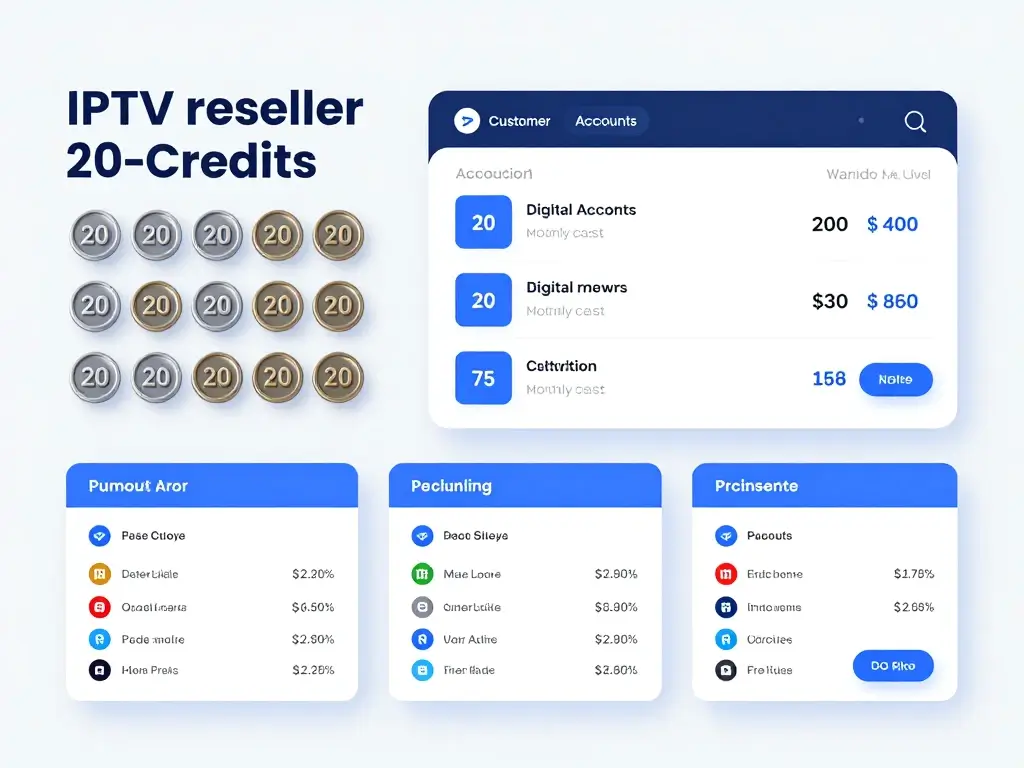
When you search for IPTV Reseller 20 Credits price, you’ll quickly discover that advertised prices can vary significantly. That doesn’t automatically mean one seller is expensive and another is cheap. The packages may simply contain different things.
A meaningful comparison requires you to look beyond the initial purchase amount.
Consider two hypothetical offers. Provider A might advertise 20 credits at a very low upfront price but require frequent renewals, provide minimal support, and impose a short credit-expiration period. Provider B might charge more but provide longer customer subscriptions, clearer documentation, stronger support, and better renewal economics.
If you compare only the initial purchase price, Provider A appears to win. If you calculate your total cost over the life of the customer relationship, the result could be completely different.
That is why the most useful pricing metric isn’t simply “How much do 20 credits cost?“ It’s “How much does each usable customer activation cost after all mandatory expenses are considered?”
Factors That Affect IPTV Reseller 20 Credits Pricing
Several factors can influence the price of an IPTV reseller package.
Subscription Duration
A credit connected to a shorter subscription period should not be compared directly with a credit connected to a longer period. Duration changes the underlying value.
Number of Customer Activations
If a provider uses one credit per customer activation, 20 credits could potentially correspond to 20 initial customers. But you must confirm that arrangement rather than assuming it.
Service Tier
Some providers may offer multiple service tiers. Different tiers can require different numbers of credits or have different costs.
Reseller Dashboard
A basic dashboard may simply show your credit balance and customer accounts. A more developed platform may provide reporting, account status, renewal information, and administrative tools.
Technical Support
Support has real economic value. If you’re responsible for customer communication, a provider that responds quickly can reduce the amount of time you spend troubleshooting.
Renewal Pricing
A low introductory package price is less attractive if renewals are significantly more expensive. Your business model should account for recurring costs from the beginning.
Geographic Availability
Content licensing can be territorial. A service authorized in one country or region may not have the rights to distribute the same programming elsewhere. You should confirm that the service you intend to resell is authorized for the relevant U.S. market.
Payment and Administrative Fees
Your real cost can also include transaction fees, taxes, platform charges, or other mandatory expenses. Keep these in your calculations.
The Federal Trade Commission emphasizes the importance of truthful advertising and substantiated claims when businesses market products and services online.
IPTV Reseller 20 Credits Price Comparison
The following framework is more useful than comparing headline prices alone:
| Package Factor | What You Should Check | Why It Matters |
|---|---|---|
| Upfront price | Total amount required for 20 credits | Determines initial investment |
| Effective credit cost | Total cost ÷ usable credits | Enables meaningful comparisons |
| Credit validity | Expiration period | Prevents unexpected losses |
| Subscription duration | What each credit provides | Determines customer value |
| Renewal cost | Cost of continuing customers | Critical for long-term economics |
| Dashboard | Available management features | Affects administrative efficiency |
| Support | Availability and response process | Helps you handle customer problems |
| Compatibility | Officially supported devices | Reduces compatibility complaints |
| Authorization | Rights to distribute the service/content | Fundamental to lawful operation |
| Refund policy | Conditions and deadlines | Reduces financial uncertainty |
| Upgrade options | Ability to purchase more credits | Supports growth |
This table also gives you a useful template when contacting providers. Instead of asking, “How much are 20 credits?” you can ask for each item separately.
That approach makes it harder for an attractive headline price to hide important conditions.
What Features Should an IPTV Reseller 20 Credits Package Include?
Price gets attention, but features determine how easy the package is to operate.
If you intend to build a small legitimate reseller business, you should think of your provider as part of your infrastructure. A weak dashboard or poor support process can create work for you every day. A reliable system, by contrast, can make customer administration considerably easier.
The best feature set will depend on your business model, but there are several areas worth examining before you buy.
Reseller Dashboard and Account Management
A reseller dashboard should make routine administration straightforward.
At minimum, you should be able to understand:
- How many credits remain.
- Which customer accounts are active.
- Which subscriptions are approaching renewal.
- Which accounts are inactive or canceled.
- What actions are available to you.
- What support options are available.
More advanced systems may offer reporting, customer search, renewal reminders, account notes, and other administrative functions.
You don’t necessarily need the most sophisticated dashboard available. If you’re beginning with only 20 credits, an unnecessarily complex platform could actually make your operation harder to manage.
Instead, look for clarity.
You should be able to log in and quickly answer basic questions about your business. If it takes multiple screens to determine how many credits you have remaining, or if customer status is difficult to interpret, the platform may create unnecessary administrative overhead.
Device and Platform Compatibility
Device compatibility is another major consideration.
Your customers may expect a service to work across the devices they already own, but compatibility is never something you should promise without verification. Different providers may support different operating systems, applications, browsers, smart-TV platforms, or streaming hardware.
Your pre-purchase checklist should therefore include:
- Supported smart-TV platforms.
- Supported mobile operating systems.
- Supported computer environments.
- Supported streaming devices.
- Browser compatibility where applicable.
- Minimum network requirements.
- Official installation instructions.
- Account limitations by device.
The key word is officially.
Avoid advertising a service as “works on everything” unless you have authoritative documentation supporting that claim. The more devices you advertise, the more customer-support questions you may receive.
You should also distinguish between the technology used to deliver the service and the rights to the programming itself. Device compatibility does not establish that a provider has the necessary rights to distribute particular channels or programs.
Customer Support and Technical Assistance
Technical support is one of the easiest features to underestimate.
Imagine that you sell a legitimate service to 15 customers. Three customers experience a login problem on the same afternoon. If the provider’s support team responds quickly and provides clear instructions, the situation may be manageable.
If support takes several days to respond, you become the support desk.
Ask the provider:
- What support channels are available?
- Is support provided by email, ticket, chat, or another method?
- What are the normal response times?
- Is reseller-specific support available?
- Are technical guides provided?
- Is there a knowledge base?
- Are maintenance notices communicated?
- What happens during a service outage?
Don’t judge support solely by how quickly a salesperson responds before you purchase. Sales communication and technical support are not always handled by the same team.
Service Reliability and Performance
Reliability is difficult to evaluate from a marketing page.
Claims such as “100% uptime,” “zero buffering,” or “guaranteed performance” should make you look for evidence rather than simply accepting the wording.
Ask what the provider actually measures.
For example:
- Is uptime monitored?
- Are maintenance windows announced?
- Is there redundant infrastructure?
- How are incidents communicated?
- Are performance expectations documented?
- Is there a history of service interruptions?
- Are there geographic limitations?
Your customers will judge you based on their experience, even when a problem originates with the upstream provider.
That means your provider selection directly affects your reputation.
IPTV Reseller 20 Credits: Advantages and Disadvantages
A 20-credit package can be useful, but it isn’t automatically the best option for every reseller.
The biggest advantage is the relatively small initial commitment. The biggest disadvantage is limited capacity and potentially less favorable unit economics compared with larger packages.
Understanding both sides helps you avoid making a decision based purely on enthusiasm.
| Advantage | Potential Drawback |
|---|---|
| Lower initial commitment | Limited customer capacity |
| Useful for testing demand | May have a higher per-credit cost |
| Easier for beginners | Less suitable for rapid growth |
| Smaller financial exposure | Credits may expire |
| Can validate provider quality | Larger packages may offer discounts |
| Easier to manage initially | Frequent replenishment may become inconvenient |
Advantages of Starting With 20 Credits
The first advantage is risk management.
If you’re new to the reseller model, you don’t yet know exactly how much legitimate customer demand you’ll generate. A 20-credit allocation allows you to learn without making a large upfront commitment.
The second advantage is operational testing.
You can determine whether the provider’s dashboard, support, billing, documentation, and service quality meet your expectations before scaling.
The third advantage is flexibility.
If the provider does not meet your requirements, you’ve limited the amount of inventory you need to unwind. That doesn’t eliminate financial risk, but it can reduce it.
A small allocation can also help you develop your business processes. You can test your customer onboarding workflow, support communication, renewal reminders, record keeping, and marketing messages.
That experience can be more valuable than simply buying a large package at a lower unit price.
Potential Disadvantages
The main limitation is scale.
Twenty credits won’t support a large customer base if each customer consumes one credit. Even if your provider offers an efficient credit structure, you’ll eventually need to understand when the package stops being economical.
A second concern is unit cost.
Providers sometimes offer volume discounts, meaning a 20-credit package could have a higher effective cost per credit than a larger allocation.
Another issue is expiration.
If credits expire before you can use them, your effective cost rises. This is especially important when you’re testing a new business and don’t yet have predictable demand.
Finally, a small package can encourage short-term thinking. You might focus on getting customers quickly without first confirming whether the underlying service is properly authorized and sustainable.
A legitimate business should prioritize long-term viability over a quick customer count.
How to Choose the Best IPTV Reseller 20 Credits Package
There isn’t one universal “best” package.
The best IPTV Reseller 20 Credits package for you is the one that aligns with your expected customer volume, budget, operational requirements, and legal responsibilities.
Use the following process to compare offers systematically.
1. Compare the True Cost, Not Just the Advertised Price
Start by calculating the effective cost per usable activation.
A simple formula is:
Effective credit cost = Total mandatory package cost ÷ Number of usable credits
Suppose a hypothetical provider charges $200 for 20 usable credits.
Your basic cost per credit would be:
$200 ÷ 20 = $10 per credit
But suppose the same provider also charges a mandatory $30 setup fee.
Your actual initial cost becomes:
($200 + $30) ÷ 20 = $11.50 per credit
Now suppose another provider charges $240 with no setup fee and offers 20 credits.
That provider’s effective initial cost is:
$240 ÷ 20 = $12
At first glance, the first provider looked cheaper. Once the mandatory fee is included, the gap is much smaller.
Your calculations should also account for renewal expenses where relevant.
Don’t stop at the checkout price.
2. Check What One Credit Actually Provides
This is arguably the most important question in the entire buying process.
Ask the provider to define a credit in concrete terms.
You need to know:
- Subscription length.
- Customer eligibility.
- Activation rules.
- Renewal requirements.
- Credit expiration.
- Replacement rules.
- Upgrade rules.
- Cancellation rules.
- Refund conditions.
Never assume that “20 credits” means “20 customers for one month” unless the provider explicitly says so.
If the provider’s answer is difficult to understand, ask for a written example.
For instance:
“If I purchase 20 credits today, what exactly can I provide to one customer, for how long, and how many credits would that customer consume?”
A straightforward answer is a good sign.
A vague answer deserves further investigation.
3. Verify Licensing and Legal Compliance
This is where price should become secondary.
In the United States, copyright law gives copyright owners important exclusive rights, including rights concerning public performance of audiovisual works. The Copyright Office has specifically explained that internet retransmission of television programming generally requires authorization unless a relevant statutory exception or license applies.
The Copyright Office has also explained that unauthorized streaming can implicate copyright’s public-performance right and, depending on the circumstances, other exclusive rights.
That means you shouldn’t evaluate a reseller package solely by asking whether the technology works.
Ask whether the provider is authorized to distribute what it is selling.
You should look for:
- Clear business identification.
- Terms of service.
- Licensing or distribution information.
- Appropriate territorial rights.
- Transparent business contact information.
- A legitimate billing process.
- A clear explanation of what you’re authorized to resell.
Be cautious if a provider makes extraordinary claims about access to premium programming while offering little or no information about licensing.
4. Evaluate Support Before Buying
Support becomes especially important when you are responsible for customers.
A good provider should be able to tell you how support works before you pay.
Consider asking:
“If one of my customers experiences a service problem, what is my escalation process?”
The answer tells you a lot.
A provider that has documented escalation procedures is easier to work with than one that simply says, “Contact us if there’s a problem.”
You should also establish whether support is included in the package or charged separately.
5. Check Supported Devices
Don’t rely on generic phrases such as “all devices supported.”
Ask for an official compatibility list.
Your own customer base might include people using:
- Smart televisions.
- Mobile devices.
- Tablets.
- Computers.
- Authorized streaming hardware.
- Web browsers.
The exact supported platforms should come from the provider’s current documentation.
You should then build your marketing around those documented capabilities rather than promising more than the provider can support.
6. Examine Scalability
A 20-credit package makes sense only if you know what happens afterward.
Ask:
- Can you purchase additional credits?
- Are larger packages available?
- Does the per-credit price decrease at higher volumes?
- Can you remain on the same reseller dashboard?
- Is customer data retained when you upgrade?
- Are there account limits?
- Does the provider support higher customer volumes?
The best small package isn’t necessarily the one with the lowest initial price. It may be the one that gives you a straightforward path from 20 customers to a larger, sustainable operation.
IPTV Reseller 20 Credits vs. Larger Reseller Packages
Once you understand how the credit system works, you can compare a 20-credit package with larger alternatives.
The key issue is whether you’re paying for unused capacity.
| Factor | 20 Credits | Larger Package |
|---|---|---|
| Initial investment | Lower | Higher |
| Financial exposure | Lower | Higher |
| Customer capacity | Smaller | Larger |
| Unit pricing | May be higher | May be lower |
| Testing ability | Excellent | Less flexible |
| Scaling | Limited initially | Better |
| Best suited for | Beginners/testing | Established demand |
When 20 Credits Is the Better Choice
Twenty credits may make sense when you are starting from zero.
You don’t yet know how many customers you’ll acquire, so a smaller package allows you to validate the business model.
It’s also appropriate when you’re testing a new provider.
Rather than buying hundreds of credits because the per-unit price looks attractive, you can start with a smaller allocation and assess:
- Service reliability.
- Customer experience.
- Support quality.
- Administrative workload.
- Renewal process.
- Billing transparency.
- Documentation.
If those areas perform well, you can consider expanding.
This is similar to how you might evaluate other business suppliers: start with a manageable commitment, verify the relationship, and scale based on evidence.
When to Upgrade to a Larger Package
A larger package becomes more interesting when demand is predictable.
Suppose you’ve consistently used most of your 20 credits and regularly need more. At that point, the time and cost involved in replenishing small allocations may become inefficient.
You should compare the larger package based on total economics rather than assuming the discount is worthwhile.
Calculate:
Additional package cost ÷ additional usable credits
Then compare that result with your current effective cost.
You should also ask whether the larger package changes anything about the provider’s terms.
A bulk purchase isn’t a bargain if it introduces stricter expiration rules, limited refunds, or an unnecessarily large financial commitment.
How to Calculate IPTV Reseller Profitability
If you’re considering an IPTV reseller business, profitability should be analyzed before you purchase your credits.
Don’t start with the question, “How much can I charge customers?”
Start with the question:
“What will it actually cost me to acquire, serve, and retain one customer?”
That difference is important.
Your gross revenue is not your profit.
Basic IPTV Reseller Profit Formula
A simple starting point is:
Gross margin = Customer revenue − Direct service cost
For a more realistic estimate:
Net profit = Customer revenue − service costs − payment fees − marketing costs − support costs − refunds − taxes − other operating expenses
This matters because reseller businesses have costs beyond the initial credit package.
You may have expenses related to:
- Website hosting.
- Payment processing.
- Advertising.
- Customer support.
- Business software.
- Accounting.
- Refunds.
- Taxes.
- Legal and compliance work.
- Customer acquisition.
Your credit cost is only one component.
Example 20-Credit Calculation
Consider a purely hypothetical example.
Assume you purchase:
- 20 usable credits.
- Package price: $200.
- Effective credit cost: $10.
- Average customer price: $20.
If one credit legitimately corresponds to one qualifying customer subscription under your provider’s terms, then 20 customers could generate:
20 × $20 = $400 in customer revenue
Your initial package cost would be $200.
The simple difference would be:
$400 − $200 = $200
But that $200 should not be described as net profit.
You still have to account for other expenses.
| Metric | Hypothetical Example |
|---|---|
| Package cost | $200 |
| Usable credits | 20 |
| Effective credit cost | $10 |
| Customer price | $20 |
| Potential customer revenue | $400 |
| Difference before other expenses | $200 |
| Marketing | Deduct separately |
| Payment processing | Deduct separately |
| Support | Deduct separately |
| Taxes | Deduct separately |
| Refunds/other costs | Deduct separately |
This is why you should be cautious with reseller websites that promise guaranteed income or unusually high profit margins.
The Federal Trade Commission states that advertising claims must be truthful, non-deceptive, and supported by appropriate evidence.
Your own marketing should follow the same principle.
Common Mistakes When Buying IPTV Reseller Credits
The biggest mistakes usually occur when buyers focus on the headline price and ignore the business underneath it.
Choosing the Cheapest Package
Cheap doesn’t automatically mean bad.
But price without context is meaningless.
A $100 package and a $200 package cannot be compared until you know what each one includes.
Ask yourself:
- How long does the service last?
- What does one credit represent?
- What happens when customers renew?
- Are there mandatory fees?
- Does the credit expire?
- What support is included?
- Is the provider authorized to distribute the service?
Only then can you make a meaningful comparison.
Ignoring Renewal Pricing
Renewal pricing is one of the most important figures in a recurring-service business.
Your first purchase might be promotional, while subsequent renewals could cost considerably more.
Build your financial model around normal pricing rather than assuming promotional pricing will continue forever.
If the provider does not clearly explain renewal costs, ask before purchasing.
For U.S. consumers and businesses, transparent subscription terms matter. The FTC has repeatedly emphasized the importance of clear disclosures around recurring charges and cancellation practices.
Assuming Every Credit Is Equivalent
This mistake is extremely common.
A “credit” is simply a unit defined by the provider.
You need to determine:
Credit → product/service → duration → customer → renewal
Without that chain, the number 20 tells you very little.
Failing to Read the Terms
Terms can contain information that completely changes the economics of a package.
Pay attention to:
- Expiration dates.
- Refund conditions.
- Renewal terms.
- Cancellation procedures.
- Account suspension rules.
- Geographic restrictions.
- Acceptable-use requirements.
- Customer limits.
- Transfer restrictions.
If you cannot find the terms, don’t assume that everything will be flexible later.
Scaling Before Testing Demand
A larger package can appear more profitable because the price per credit is lower.
But unused credits can become a liability.
Imagine you purchase 500 credits and discover that your realistic demand is only 30 customers. The apparent bulk discount may not matter because most of your inventory isn’t generating revenue.
Starting with 20 credits can give you useful demand data before you make a larger commitment.

IPTV Reseller 20 Credits Buying Checklist
Before you purchase, run through the following checklist.
Before You Purchase
- Confirm the total purchase price.
- Determine exactly what one credit represents.
- Confirm the subscription duration.
- Check whether credits expire.
- Understand renewal pricing.
- Review mandatory fees.
- Verify supported devices.
- Review reseller dashboard features.
- Confirm support channels.
- Check the provider’s business identity.
- Review terms and conditions.
- Confirm authorization/licensing.
- Understand refund conditions.
- Calculate your effective cost per customer.
- Determine how additional credits are purchased.
- Check whether larger packages offer meaningful savings.
Questions to Ask the Provider
If you are serious about buying, send the provider a concise list of questions.
1. What exactly does one credit provide?
Don’t accept a generic answer. Ask for a practical example.
2. How long does the customer’s subscription last?
Duration affects your economics and what you can legitimately advertise.
3. Do unused credits expire?
If they do, ask exactly when and whether extensions are possible.
4. How are renewals handled?
Determine whether customers consume additional credits when renewing.
5. What devices are officially supported?
Request documentation rather than relying on a salesperson’s verbal promise.
6. What reseller tools are included?
Ask for a list of dashboard functions.
7. What technical support is available?
Ask about hours, response times, and escalation.
8. What are the normal renewal and upgrade prices?
This is essential for long-term planning.
9. What authorization covers the service?
Ask for information explaining the provider’s rights to distribute the relevant programming or service in your target market.
10. Are there additional mandatory fees?
Your pricing model depends on the answer.
A reputable provider should be able to answer straightforward commercial questions without making you feel that you’re asking for unreasonable information.
Best IPTV Reseller 20 Credits Package: What Makes One Stand Out?
Rather than declaring a particular provider the “best” without independently verified and current information, you can create your own scoring system.
This is a better approach because the best package for a beginner may not be the best package for an established reseller.
Consider using a weighted evaluation model.
| Evaluation Category | Example Weight |
|---|---|
| Licensing/authorization | 25% |
| Pricing transparency | 20% |
| Reliability | 15% |
| Customer support | 15% |
| Dashboard/features | 10% |
| Device compatibility | 10% |
| Scalability | 5% |
You can adjust these percentages.
For example, if you’re primarily concerned with legal and operational risk, increase the weighting for authorization and reliability.
If you’re testing a new business with a very small budget, you might place more emphasis on initial cost and credit flexibility.
The important thing is to use the same criteria for every provider.
The Ideal 20-Credit Package for Beginners
As a beginner, you should prioritize simplicity.
Your ideal package may include:
- Transparent pricing.
- Clearly defined credits.
- No confusing mandatory fees.
- Reasonable credit validity.
- Straightforward dashboard access.
- Strong documentation.
- Responsive technical support.
- Clear authorization information.
- Official device compatibility information.
- A simple upgrade path.
You don’t necessarily need every advanced feature.
What you need is a dependable foundation.
A package that is easy to understand and manage can be more valuable than a package loaded with features you never use.
The Ideal Package for Growing Resellers
If you already have demand, your priorities change.
You may care more about:
- Volume pricing.
- Higher customer capacity.
- Automated account management.
- Reporting.
- Renewal workflows.
- Scalable support.
- Consistent infrastructure.
- Larger allocations.
- Business-level documentation.
- Predictable billing.
At this stage, you should calculate your costs over several months rather than looking only at the first purchase.
The right provider should be able to explain how your relationship changes as your customer volume grows.

How to Compare IPTV Reseller 20 Credits Packages More Effectively
You can make your comparison much easier by putting every provider into the same spreadsheet.
Create columns for:
| Comparison Item | Provider A | Provider B | Provider C |
|---|---|---|---|
| 20-credit price | — | — | — |
| Cost per credit | — | — | — |
| Credit validity | — | — | — |
| Subscription duration | — | — | — |
| Renewal cost | — | — | — |
| Mandatory fees | — | — | — |
| Dashboard | — | — | — |
| Support | — | — | — |
| Device compatibility | — | — | — |
| Authorization evidence | — | — | — |
| Refund terms | — | — | — |
| Upgrade options | — | — | — |
This forces you to compare like with like.
It also makes hidden differences easier to identify.
One provider may initially appear 20% cheaper, but after you add mandatory fees and account for a shorter service period, the difference could disappear.
You can also create a score from 1 to 5 for each category.
For example:
- 5 = Excellent
- 4 = Good
- 3 = Acceptable
- 2 = Weak
- 1 = Unsatisfactory
Avoid giving a provider a high score for authorization merely because it claims to be licensed. Your score should reflect the quality of the evidence available to you.
What Does “Cheap IPTV Reseller 20 Credits” Really Mean?
Searchers often begin with price because they want to minimize their upfront investment.
That’s understandable.
But “cheap” can mean several different things.
It can mean:
- Low upfront price.
- Low cost per credit.
- Low cost per month.
- Low cost per customer.
- Low total operating cost.
- Low financial risk.
These aren’t the same thing.
A $150 package can be more expensive in practical terms than a $200 package if the $150 package delivers fewer usable customer months or carries higher renewal costs.
You should therefore replace the phrase “cheapest package” with “lowest total cost for the service I actually need.”
That distinction can dramatically improve your buying decisions.
What Should You Know About IPTV Licensing in the United States?
If you’re targeting U.S. customers, licensing deserves particular attention.
The fact that a provider can technically transmit a television channel over the internet doesn’t mean that the provider automatically has permission to distribute that channel.
Copyright law can give rights holders control over important uses of their works. The Copyright Office explains that copyright owners have exclusive rights that include public performance for relevant categories of works, and it has specifically addressed the copyright implications of internet retransmission.
The distinction matters for you because your business reputation can be affected by the upstream provider.
If you market a service to U.S. customers, you should understand what you’re actually authorized to sell.
Questions About Licensing
Ask the provider:
- Who owns or licenses the programming?
- Is the service authorized for internet distribution?
- Does the authorization cover the United States?
- Does the authorization permit resale?
- Are you permitted to market the service under your business?
- Are there territorial restrictions?
- Are there restrictions on advertising specific programming?
If the provider refuses to answer basic questions, reconsider the relationship.
A legitimate business should not require you to ignore obvious legal questions.
Why “Thousands of Channels” Shouldn’t Be Your Main Selection Criterion
A very large channel count can sound impressive.
But quantity doesn’t tell you whether the service is reliable, lawful, compatible, or commercially sustainable.
Your customers generally care about whether the service they expect actually works and whether the provider can continue offering it.
Instead of asking:
“How many channels are included?”
ask:
“What programming is authorized, what is the service’s reliability record, and what are the actual terms?”
That shift from quantity to quality is one of the most important improvements you can make to your buying process.
How to Market an IPTV Reseller Business Responsibly
If you’re planning to resell an authorized IPTV service, your marketing should accurately reflect what you’re actually allowed to offer.
Avoid exaggerated statements.
For example, don’t promise:
- Guaranteed zero buffering.
- Every channel in every country.
- Permanent access.
- Guaranteed income.
- Unlimited device compatibility.
- Guaranteed uptime.
Unless you can substantiate a claim, don’t make it.
The FTC explains that advertising claims must be truthful and supported by evidence, and it specifically warns businesses against misleading online advertising.
Be Clear About Pricing
Your customer should understand:
- Initial price.
- Subscription period.
- Renewal price.
- Mandatory fees.
- Optional upgrades.
- Cancellation terms.
Don’t advertise a low introductory number prominently while hiding recurring charges in difficult-to-read text.
The FTC has taken action against online businesses over allegedly deceptive subscription practices, including cases involving recurring charges and unclear pricing.
Even where a particular FTC rule may apply differently depending on the product and transaction, transparent pricing is a strong business practice.
Make Cancellation Understandable
Your customer should know how to cancel.
Don’t design a process that requires customers to repeatedly contact support, navigate unnecessary obstacles, or guess whether their subscription has actually ended.
Transparent cancellation can improve customer trust and reduce disputes.
How to Build a Simple Customer Onboarding Process
Once you have an authorized provider, your customer experience should be simple.
A basic onboarding workflow might look like:
Step 1: Explain the Service
Tell the customer exactly what they’re purchasing.
Step 2: Explain Compatibility
Provide the provider’s official compatibility information.
Step 3: Confirm the Subscription Terms
Make the duration and renewal conditions clear.
Step 4: Provide Setup Instructions
Use official documentation whenever possible.
Step 5: Confirm Activation
Make sure the customer knows how to determine whether their account is active.
Step 6: Explain Support
Tell the customer how to contact you and when they should contact the upstream provider, if applicable.
Step 7: Record the Customer Information You Actually Need
Avoid collecting unnecessary personal information.
The simpler your onboarding process, the easier it becomes to scale.
You don’t want every new customer to require a 30-minute manual explanation.
How to Reduce Customer Support Problems
Many reseller businesses underestimate support workload.
A customer may contact you because:
- They entered credentials incorrectly.
- Their device isn’t supported.
- Their internet connection is unstable.
- They misunderstood the subscription duration.
- They expect a feature that wasn’t included.
- They need renewal assistance.
- They have a billing question.
You can reduce many of these issues through better documentation.
Create a simple customer help center containing:
- Supported devices.
- Setup instructions.
- Account information.
- Troubleshooting basics.
- Subscription terms.
- Renewal information.
- Cancellation instructions.
- Contact information.
You should also distinguish between service-side problems and customer-side problems.
If the provider is experiencing an outage, repeatedly asking customers to reinstall an application won’t solve anything.
A documented escalation process saves time.
How to Decide When to Buy More Than 20 Credits
Don’t automatically upgrade when you have used your first few credits.
Look for evidence of consistent demand.
A useful trigger might be:
- Most of your existing credits are allocated.
- You have recurring customer demand.
- Your customer acquisition cost is understood.
- Your support workload is manageable.
- Your provider has demonstrated acceptable reliability.
- Renewal economics are sustainable.
- You have verified the provider’s authorization.
- You understand your cancellation and refund exposure.
Only then should you consider a larger allocation.
You should also maintain a cash reserve.
Buying inventory with all your available business cash can create unnecessary pressure. A reseller operation still needs money for marketing, payment processing, customer refunds, software, taxes, and other expenses.
Growth should improve your financial position rather than weaken it.
IPTV Reseller 20 Credits: A Practical Decision Framework
If you’re still unsure, use this five-stage framework.
Stage 1: Legitimacy
Can the provider demonstrate that the service you’re selling is authorized?
If the answer is no, stop there.
Stage 2: Economics
Does the cost per usable customer activation make sense?
Calculate the full cost rather than relying on the advertised price.
Stage 3: Operations
Can you manage customers efficiently?
Evaluate the dashboard, documentation, support, and renewal process.
Stage 4: Customer Experience
Will your customers receive clear information and reliable support?
Your reputation depends on this.
Stage 5: Scalability
Can the relationship grow if your customer base grows?
If the provider becomes difficult to manage at 20 customers, a low initial price may not matter.
This framework keeps you focused on the entire business rather than one attractive number.
IPTV Reseller 20 Credits: Frequently Asked Questions
What Is an IPTV Reseller 20 Credits Package?
An IPTV Reseller 20 Credits package generally refers to a reseller allocation containing 20 credits that can be used according to a provider’s specific rules. The meaning of a credit is not universal, so you need to verify what each credit provides, how long the associated service lasts, whether renewals consume additional credits, and whether unused credits expire.
For example, one provider may define a credit around a particular subscription activation, while another may use a different structure. You should therefore avoid assuming that 20 credits automatically means 20 customers for a particular period.
The safest approach is to request written documentation explaining the credit system before you purchase.
How Much Does an IPTV Reseller 20 Credits Package Cost?
There is no single universal price for an IPTV Reseller 20 Credits package.
Pricing can depend on the subscription duration, service tier, provider infrastructure, dashboard features, support, region, renewal conditions, and other terms.
Instead of searching only for the lowest advertised price, calculate the effective cost per usable credit.
You should also consider:
- Mandatory fees.
- Renewal costs.
- Taxes.
- Payment-processing costs.
- Credit expiration.
- Refund conditions.
A package with a higher upfront price can provide better value if its terms are significantly stronger.
Is IPTV Reseller 20 Credits Suitable for Beginners?
It can be.
A 20-credit package may give you a relatively small starting point for evaluating an authorized service, learning the reseller platform, testing customer demand, and developing your support process.
It can also reduce your initial exposure compared with purchasing a much larger allocation.
However, you should not purchase simply because 20 credits sounds like a manageable number. First confirm what the credits represent and whether the provider has the appropriate rights and infrastructure for the service you intend to resell.
How Many Customers Can I Serve With 20 IPTV Reseller Credits?
There is no universal answer.
The number of customers depends on how the specific provider defines and consumes its credits.
If one credit corresponds to one qualifying customer activation, 20 credits might correspond to 20 initial activations. But another provider could use a different structure.
Ask the provider for a concrete example before purchasing.
A useful question is:
Get the answer in writing.
What Features Should I Look for in an IPTV Reseller 20 Credits Package?
You should look for transparent credit definitions, a practical reseller dashboard, official device compatibility information, responsive support, clear renewal terms, reliable service infrastructure, and evidence that the underlying service is properly authorized for distribution.
Useful features may include:
- Customer account management.
- Credit balance tracking.
- Renewal information.
- Reporting.
- Technical documentation.
- Support escalation.
- Account status information.
The most important feature, however, is not a dashboard button.
It’s confidence that the service you’re selling is legitimate and sustainable.
Can I Upgrade From 20 IPTV Reseller Credits to a Larger Package?
Many reseller models may offer larger allocations, but you should confirm the upgrade process with your provider.
Ask whether:
- Additional credits can be purchased at any time.
- Larger packages offer volume discounts.
- Your existing account can remain active.
- Customer data remains available.
- Expiration terms change.
- Support changes at higher volumes.
- Larger packages require a new agreement.
An upgrade path is particularly important if you’re using 20 credits as a test allocation.
Do IPTV Reseller Credits Expire?
They may.
Expiration rules are determined by the provider, so you should never assume that unused credits remain available indefinitely.
Ask:
- When does the expiration period begin?
- Is it based on purchase date?
- Is it based on activation date?
- Can unused credits be extended?
- Are expired credits refundable?
- Are credits restored if a customer cancels?
Expiration can materially change the effective price of your package.
Is IPTV Reselling Legal in the United States?
The answer depends on what you are reselling and whether the necessary rights and authorizations exist.
IPTV itself is a method of delivering audiovisual content over internet networks. The legal issue is not simply whether the service uses IPTV technology; it concerns the content, rights, licenses, contracts, distribution arrangements, and applicable laws.
The U.S. Copyright Office explains that copyright owners hold exclusive rights over protected works and has specifically addressed the copyright implications of internet retransmission and unauthorized streaming.
Therefore, you should only resell services that you are authorized to distribute and should obtain appropriate legal advice if you’re unsure about your particular business model.
How Can I Choose the Best IPTV Reseller 20 Credits Package?
Start with the provider’s legitimacy and authorization.
Then compare:
- Total package cost.
- Effective cost per usable credit.
- Subscription duration.
- Renewal pricing.
- Credit expiration.
- Dashboard features.
- Customer support.
- Device compatibility.
- Refund terms.
- Scalability.
Don’t choose based solely on price.
The best package is the one that provides the combination of value, transparency, reliability, support, and lawful authorization that your business requires.
Should You Buy 20 Credits or a Larger Package?
If you’re new and your demand is uncertain, 20 credits can be a sensible starting point.
If you already have consistent demand, a larger package may produce better unit economics.
The key is to compare the total financial commitment with your realistic customer acquisition rate.
Don’t buy hundreds of credits simply because the per-credit price looks cheaper.
Unused inventory isn’t necessarily an asset if it expires before you can use it.
What Should You Ask an IPTV Reseller Provider Before Paying?
At minimum, ask:
- What exactly does one credit represent?
- How long does each activation last?
- What happens at renewal?
- Do unused credits expire?
- What devices are officially supported?
- What reseller tools are included?
- What support is available?
- What are the standard renewal prices?
- Are there mandatory fees?
- What refund terms apply?
- What authorization covers the service?
- Are you permitted to resell it to customers in the United States?
If the provider cannot give you clear answers, don’t let a low price rush your decision.
Final Verdict: Is IPTV Reseller 20 Credits Right for You?
But 20 credits are not automatically a good deal.
An IPTV Reseller 20 Credits package can be a practical starting point when you’re evaluating an authorized IPTV or digital television distribution business, particularly if you’re new and want to limit your initial commitment.
The real value depends on what those credits represent.
Before purchasing, you should understand the service duration, customer activation rules, renewal costs, credit expiration, dashboard capabilities, technical support, device compatibility, and—most importantly—the provider’s authorization to distribute the underlying programming.
You should also calculate your economics realistically. Your purchase price is only one part of the equation. Marketing, payment processing, customer support, refunds, taxes, software, and other operating expenses can all affect the amount you ultimately retain.
Most importantly, don’t allow an attractive price or an impressive channel count to replace proper due diligence. The U.S. Copyright Office has made clear that unauthorized internet retransmission and streaming of protected programming can implicate copyright rights, while U.S. consumer-protection authorities emphasize truthful, transparent online marketing and subscription practices.
Your Next Step
If you’re comparing IPTV Reseller 20 Credits packages right now, create a simple comparison sheet and evaluate every provider using the same criteria.
Start with these seven questions:
- What exactly does one credit provide?
- What is my true cost per usable credit?
- How long does the customer’s subscription last?
- What will renewal actually cost?
- Do unused credits expire?
- What support and reseller tools are included?
- Can the provider demonstrate appropriate authorization for the service I intend to resell?
If a provider gives you clear, verifiable answers to all seven, you have a much stronger foundation for making a decision.
If it avoids the questions, hides the terms, emphasizes an unusually low price, or cannot explain its authorization, don’t let the promise of cheap credits persuade you.
The smartest reseller isn’t necessarily the person who buys the most credits or finds the lowest advertised price. It’s the person who understands exactly what they’re buying, what they’re allowed to sell, what it will really cost, and whether the provider can support the business over the long term.
For a new reseller, 20 credits can be enough to start learning. For an established operation, they may be only the first step toward a larger package. Either way, your goal should remain the same: choose a transparent, reliable, properly authorized service that creates genuine value for you and your customers.









