
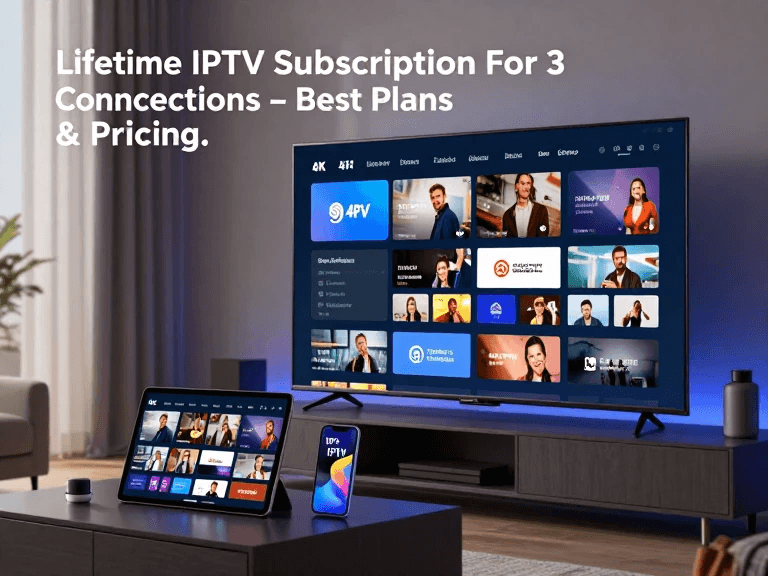
If you are looking for a Lifetime IPTV Subscription For 3 Connections, you are probably trying to solve a simple problem: you want flexible access to live television and on-demand entertainment across several devices without paying for multiple separate subscriptions. A three-connection plan can be especially useful for households where different people want to watch different content at the same time. One person might be watching a live sports event in the living room while another watches a movie in the bedroom and someone else uses a phone or tablet.
But choosing a lifetime IPTV plan is not simply about finding the lowest advertised price. You need to understand what “three connections” actually means, whether simultaneous streaming is supported, which devices are compatible, what channels and VOD content are included, how the service handles buffering, and what the provider means by “lifetime.” You should also examine the refund policy, payment options, customer support, and the provider’s terms before committing to a long-term purchase.
This guide walks you through the most important factors to consider when comparing a Lifetime IPTV Subscription For 3 Connections in the USA. You will learn how three-connection plans work, how pricing is structured, which features matter, how much internet bandwidth you may need, how to compare providers, and what questions you should ask before purchasing.
Table of Contents
What Is a Lifetime IPTV Subscription For 3 Connections?
IPTV, or Internet Protocol Television, refers broadly to television and video content delivered through an internet connection rather than traditional broadcast, cable, or satellite delivery. The technology itself is not inherently tied to one particular business model. A legitimate IPTV service can provide authorized programming over the internet, while unauthorized services may distribute copyrighted programming without the necessary rights.
A Lifetime IPTV Subscription For 3 Connections generally describes a subscription that gives you access to an IPTV service under a long-term or “lifetime” plan while allowing three supported connections. The exact meaning of both “lifetime” and “connection” depends on the provider’s terms. That is why you should never assume that every three-connection lifetime package works in exactly the same way.
For example, one provider may define three connections as three devices that can stream simultaneously. Another provider may allow you to install the service on several devices but restrict simultaneous playback to three. A third provider might use the word “connection” differently altogether.
Before you pay, read the provider’s description carefully and confirm the following:
- How many devices can be active at once
- Whether three streams can run simultaneously
- Whether devices need to be on the same network
- Whether changing devices requires additional activation
- What “lifetime” means under the provider’s terms
- Whether the subscription can be transferred
- What happens if the service is discontinued
- Whether refunds are available
The distinction between device compatibility and simultaneous connections is particularly important. Being able to install an IPTV player on three devices does not automatically mean that your subscription allows three streams at the same time.
What Does “3 Connections” Mean?
The phrase “3 connections” is one of the most important terms to understand before purchasing an IPTV subscription.
In many subscription models, a connection refers to a simultaneous stream. If a plan includes three connections, you may be able to watch three different streams at the same time, assuming the provider’s terms allow it.
For example, imagine a household with three compatible devices:
- A Smart TV in the living room
- A Fire TV device in the bedroom
- A tablet used by another family member
If the subscription explicitly supports three simultaneous connections, each device may be able to stream different content at the same time.
However, this should always be confirmed with the provider.
Three Connections Does Not Necessarily Mean Unlimited Devices
You might install an IPTV application on several compatible devices, but the number of simultaneous streams can still be limited.
For example, you could have:
- Living room TV
- Bedroom TV
- Smartphone
- Tablet
- Laptop
A subscription with three connections might allow you to have the service configured on several of these devices while limiting active streams to three at any given time.
This is why you should look for wording such as “3 simultaneous connections,” “3 concurrent streams,” or an equivalent statement in the provider’s terms.
Why Three Connections Can Be Useful
Three connections can make sense when several people in your household have different viewing preferences.
You may want to watch a football game while another household member watches a movie. At the same time, someone else might want to watch news or entertainment programming on a different device.
A three-connection subscription can therefore provide more flexibility than a single-connection plan.
What Does “Lifetime IPTV” Actually Mean?
The term lifetime IPTV deserves careful attention.
When a provider advertises a lifetime subscription, you should read its terms to determine exactly what is being promised. “Lifetime” does not necessarily mean that a service is guaranteed to operate forever under every possible circumstance.
A service depends on infrastructure, content rights, software, servers, business operations, payment systems, and other factors. If a provider’s service terms define a lifetime subscription in a particular way, those terms should be treated as the relevant description of the purchase.
Before buying a lifetime plan, ask:
- Does “lifetime” refer to the lifetime of the service?
- Is there a fixed number of years?
- Are maintenance fees possible later?
- Can the provider change included features?
- What happens if the provider stops operating?
- Is the purchase refundable?
- Are there limitations on transferring the account?
A long-term subscription can be attractive because it may eliminate recurring monthly payments, but a larger upfront payment also means you should investigate the provider carefully before purchasing.
Lifetime IPTV vs. Monthly IPTV Subscription
The main difference between a lifetime and monthly IPTV subscription is the payment structure.
A monthly plan usually spreads your spending over time. A lifetime plan typically requires a larger payment at the beginning in exchange for longer-term access under the provider’s terms.
Comparison Table
| Factor | Monthly IPTV | Annual IPTV | Lifetime IPTV |
|---|---|---|---|
| Initial cost | Lower | Moderate | Usually higher |
| Recurring payment | Yes | Usually yearly | Usually no recurring subscription fee |
| Long-term commitment | Low | Medium | High |
| Flexibility | High | Medium | Lower |
| Long-term payment planning | Monthly | Annual | Upfront |
| Best for | Testing or short-term use | Regular users | Users seeking long-term access |
There is no universal answer as to which payment structure is appropriate for everyone. Your decision depends on how frequently you expect to use the service, how comfortable you are paying upfront, and how confident you are in the provider.
A monthly plan may give you more flexibility if you are still evaluating a service. A lifetime plan may appeal to someone who wants to avoid recurring payments and intends to use the same service for a long period.
Lifetime IPTV Subscription For 3 Connections – Pricing Guide
Pricing is usually one of the first things people search for when considering a Lifetime IPTV Subscription For 3 Connections. However, there is no single universal market price.
The amount charged by a provider can depend on its infrastructure, content offering, number of connections, streaming quality, customer support, subscription terms, and other factors.
You should therefore compare the total package rather than choosing solely according to the lowest advertised number.
How Much Does a 3-Connection Lifetime IPTV Subscription Cost?
The price of a three-connection lifetime subscription can vary considerably between providers. Some providers may charge a relatively low one-time amount, while others may charge considerably more for additional features, higher connection limits, or premium support.
When comparing prices, create a simple calculation that considers:
- One-time subscription cost
- Number of included connections
- Length of access promised
- Included content
- Device compatibility
- Support availability
- Refund policy
- Additional fees
- Any future maintenance requirements
A cheap plan is not necessarily cheaper over the long term if it provides fewer simultaneous connections or has restrictions that prevent your household from using it as expected.
Likewise, a higher-priced plan is not automatically better. You should determine whether the additional cost corresponds to features you actually need.
What Determines IPTV Pricing?
Several factors can influence the price of an IPTV service.
Number of Connections
A three-connection subscription generally provides more simultaneous-use capacity than a one-connection subscription.
Content Selection
The size and organization of the live TV and VOD catalog can influence how a provider positions its plans.
Streaming Quality
Plans may advertise HD, Full HD, or 4K content. However, you should distinguish between support for a resolution and the actual quality of every channel or video.
EPG and Catch-Up Features
Electronic Program Guide functionality and catch-up features can increase convenience.
Device Compatibility
A service that supports a broad selection of platforms may be more convenient for households with different devices.
Customer Support
Technical support can be valuable if you experience activation, login, playlist, application, or playback problems.
3-Connection Lifetime IPTV Pricing Comparison
When you compare providers, use a table like the following.
| Factor | Provider A | Provider B | Provider C |
|---|---|---|---|
| 3 simultaneous connections | Verify | Verify | Verify |
| Lifetime terms | Review | Review | Review |
| Live TV | Review | Review | Review |
| VOD | Review | Review | Review |
| HD/FHD/4K | Review | Review | Review |
| EPG | Review | Review | Review |
| Catch-up | Review | Review | Review |
| Supported devices | Review | Review | Review |
| Customer support | Review | Review | Review |
| Refund policy | Review | Review | Review |
| Payment methods | Review | Review | Review |
This approach helps you avoid comparing only the headline price.
What Should You Check Before Buying?
Before purchasing a lifetime IPTV subscription, take a few minutes to investigate the offer.
First, confirm that the advertised three connections actually mean three simultaneous streams. Then check which devices are supported. After that, review the content description, refund terms, privacy policy, payment options, and customer support channels.
The Federal Trade Commission recommends researching unfamiliar online sellers, checking policies, keeping purchase records, and using safer payment methods when possible. It also warns consumers to be cautious when sellers insist on payment methods that make it difficult to recover money.
You should also search for the provider’s name together with terms such as “review,” “complaint,” or “scam.” Reviews can provide useful information, although you should remember that online reviews can be inaccurate or manipulated.
Keep copies of:
- The subscription description
- Price paid
- Order confirmation
- Refund policy
- Terms and conditions
- Customer support conversations
- Activation information
This documentation can become useful if there is a disagreement about what was advertised.
What You Should Expect From a 3-Connection IPTV Plan
A three-connection subscription is primarily about flexibility, but the overall experience depends on more than the connection count.
A useful IPTV service should have a clear interface, compatible applications or players, stable infrastructure, understandable activation instructions, and transparent subscription terms.
The exact content will vary from provider to provider.
Live TV Channels
Live television is one of the primary reasons consumers consider IPTV services.
Depending on the service and its licensing arrangements, channel categories can include:
- News
- Sports
- Entertainment
- Movies
- Kids
- Lifestyle
- International programming
- Local programming
- Music
- Documentary content
When evaluating a channel list, quantity should not be your only consideration.
A provider might advertise a very large number of channels, but that does not tell you whether the specific channels you actually watch are available.
Instead, identify your priorities.
If you mainly watch sports, check the sports offering. If you need local channels, verify those specifically. If you watch international content, check whether your preferred languages and regions are covered.
Movies and Series: Understanding VOD
VOD stands for Video on Demand.
Unlike live television, VOD allows you to choose content from a catalog rather than waiting for it to appear on a scheduled channel.
A VOD library may contain:
- Movies
- TV series
- Documentaries
- Children’s programming
- International content
- Older titles
However, VOD catalogs can change.
Movies and television programs are subject to licensing arrangements, availability, and regional rights. A title that appears in a catalog today may not necessarily remain available indefinitely.
Therefore, be cautious with providers that make absolute claims about permanent access to every title.
HD, Full HD and 4K IPTV Streaming
Video resolution is another important part of the IPTV buying decision.
The basic terminology is:
- HD: typically associated with 720p
- Full HD: commonly associated with 1080p
- 4K/UHD: commonly associated with approximately 2160p
Higher resolution can provide more detail, but resolution alone does not guarantee a better viewing experience.
Your experience can also depend on:
- Source quality
- Bitrate
- Internet connection
- Device capabilities
- Wi-Fi performance
- Server performance
- Television quality
For comparison, Netflix currently recommends at least 3 Mbps for HD, 5 Mbps for Full HD, and 15 Mbps for 4K streaming. These figures are useful as general streaming benchmarks, but IPTV services can have different technical requirements.
If you plan to use three connections simultaneously, you should consider the combined bandwidth rather than looking only at the requirement for one stream.
Electronic Program Guide (EPG)
An Electronic Program Guide, commonly called EPG, displays programming information in a guide-style interface.
Instead of opening channels one by one, you can often browse:
- Current programs
- Upcoming programs
- Program names
- Start and end times
- Channel information
- Categories
A good EPG can make a large channel list much easier to navigate.
However, EPG accuracy depends on the provider’s data source and maintenance. If the information is outdated or incomplete, the guide may not accurately reflect current programming.
When comparing IPTV plans, treat EPG as a useful feature rather than assuming that every provider offers equally accurate information.
Catch-Up TV
Catch-up TV allows you to access selected programming after it has already aired.
This can be useful when you miss a program or want to watch something without waiting for its next scheduled broadcast.
Catch-up availability can vary considerably. Some services may offer it only for selected channels or for a limited period.
Before purchasing, check:
- Which channels support catch-up
- How far back programming is available
- Whether catch-up works on your preferred device
- Whether the feature is included in your plan
Why Choose 3 Connections Instead of 1 or 2?
The main reason to consider three connections is simultaneous household use.
Imagine a household where three people have different viewing habits.
One person wants live sports. Another wants a movie. A third wants news or another program.
With a single connection, you may need to take turns. With three supported simultaneous connections, each person may be able to watch separately, subject to the provider’s terms and technical limitations.
Three Connections for Families
Three connections can be practical for families because television viewing is rarely limited to one screen.
You may have:
- Main living-room TV
- Bedroom TV
- Smartphone
- Tablet
- Laptop
- Secondary TV
You do not necessarily need to use all three connections at all times. The additional capacity simply gives your household more flexibility when simultaneous viewing is needed.
Three Connections for Shared Households
A three-connection plan may also be useful for roommates or other shared households, provided that the provider permits the intended usage.
Before sharing access, read the provider’s account rules. Some subscriptions may be intended for a single household, while others may have specific restrictions.
Three Connections vs. Separate IPTV Subscriptions
One reason consumers consider multi-connection subscriptions is to simplify household entertainment.
Instead of managing several separate subscriptions, you may prefer a plan designed for multiple simultaneous connections.
| Setup | Possible Advantage | Possible Limitation |
|---|---|---|
| One connection | Lower entry cost | Limited simultaneous viewing |
| Two connections | More flexibility | Still limited to two simultaneous streams |
| Three connections | Suitable for multiple viewers | Higher upfront cost |
| Separate subscriptions | Independent accounts | More accounts and payments |
The financial comparison depends on the actual prices involved.
Do not assume that a three-connection plan will always be cheaper. Calculate the total cost of the alternatives and compare the features included with each option.
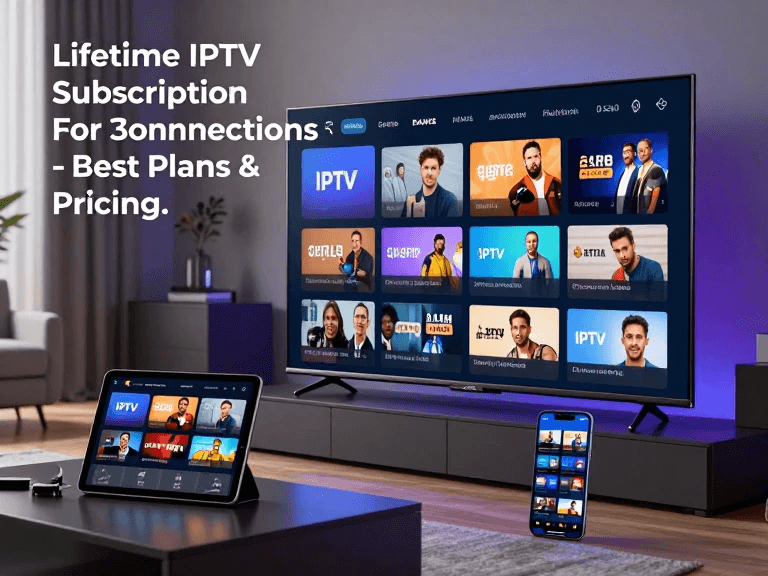
Best Devices for a Lifetime IPTV Subscription For 3 Connections
Device compatibility is essential.
Before buying a Lifetime IPTV Subscription For 3 Connections, identify the devices you intend to use.
Common platforms can include:
- Amazon Fire TV devices
- Smart TVs
- Android TV
- Android smartphones
- iPhone
- iPad
- Windows PCs
- Mac computers
- Streaming boxes
- Other compatible platforms
The exact setup depends on the IPTV service and the player it supports.
Amazon Fire TV and Firestick
Fire TV devices are popular for television streaming because they connect directly to a TV and provide access to compatible streaming applications.
If you use Fire TV, verify that the IPTV player recommended by your provider is compatible with your device and current operating system.
Do not assume that every IPTV application is officially available through every app marketplace.
Smart TVs
Many households prefer to stream directly through their Smart TV.
Depending on the television platform, the setup process can differ.
You may need to use:
- A compatible IPTV application
- A playlist
- Login credentials
- A provider-specific activation method
Check the exact instructions before purchasing.
Android Phones and Tablets
Android devices can provide convenient portable viewing.
They can be useful for:
- Travel
- Bedrooms
- Personal viewing
- Watching while away from the main television
However, mobile streaming consumes data. If you use cellular data rather than Wi-Fi, check your mobile plan’s data limits.
iPhone and iPad
Apple devices can also be used with compatible IPTV players where supported.
Application availability and installation methods can vary, so you should verify current compatibility rather than relying on an old tutorial.
What Internet Speed Do You Need for 3 IPTV Connections?
Your internet connection becomes particularly important when three devices are streaming simultaneously.
Suppose three people are watching video at the same time. Each stream requires bandwidth, and your household may also be using the internet for:
- Gaming
- Video calls
- Downloads
- Cloud backups
- Social media
- Web browsing
- Smart home devices
This means your connection needs to support more than the IPTV streams alone.
General Streaming Benchmarks
| Quality | Approximate Speed Per Stream |
|---|---|
| SD | 3–5 Mbps |
| HD | Around 3–10 Mbps |
| Full HD | Around 5–15 Mbps |
| 4K | Around 15–30+ Mbps |
These are practical ranges rather than universal IPTV requirements.
Netflix, for example, currently recommends 3 Mbps for HD, 5 Mbps for Full HD, and 15 Mbps for 4K.
For three simultaneous streams, you should consider the combined requirement.
Example
Imagine you have:
- One HD stream
- One Full HD stream
- One 4K stream
Using Netflix’s published benchmarks as a general reference, the streams alone could require at least approximately:
3 + 5 + 15 = 23 Mbps
That does not mean a 25 Mbps internet plan will necessarily provide a good experience. You still need bandwidth for other household activity and must account for Wi-Fi performance, network congestion, and overhead.
For a household relying heavily on simultaneous streaming, a faster connection can provide more headroom.
How to Reduce IPTV Buffering
Buffering can have many possible causes.
It is not automatically evidence that the IPTV service itself is responsible.
Potential causes include:
- Weak Wi-Fi signal
- Router limitations
- Network congestion
- Insufficient bandwidth
- Poor device performance
- Service-side congestion
- High household traffic
- Incorrect application configuration
Use Ethernet When Possible
A wired Ethernet connection can provide a more consistent connection than Wi-Fi in many home environments.
If your television or streaming device is close enough to your router, Ethernet can be worth considering.
Improve Wi-Fi Placement
If you rely on Wi-Fi, position the router where the signal can reach your streaming devices effectively.
Avoid placing the router behind large obstacles or inside enclosed furniture where possible.
Reduce Background Traffic
Large downloads, cloud backups, game updates, and other heavy traffic can compete with video streaming.
If several devices are using the network simultaneously, your available bandwidth may decrease.
Test Different Times
If buffering happens mainly during certain periods, note the timing.
For example, if playback works normally in the afternoon but struggles every evening, network congestion or service-side peak demand could be contributing factors.
How to Compare Lifetime IPTV Providers for 3 Connections
Comparing providers requires more than searching for the cheapest lifetime plan.
A useful comparison should include at least five areas:
- Connections
- Content
- Technology
- Customer support
- Purchase protection
Check the Number of Simultaneous Connections
This should be your first checkpoint.
Look specifically for:
3 simultaneous connections
rather than simply:
Compatible with three devices
Those statements can mean different things.
Review the Channel Selection
Do not focus only on the total channel count.
Instead, look for the categories you actually watch.
If you live in the USA, you might prioritize:
- Local programming
- News
- Sports
- Entertainment
- Movies
- Children’s content
- International channels
If international programming matters to you, check the specific countries and languages available.
Evaluate Streaming Quality
Look for clear descriptions of available resolutions.
Remember that “4K available” does not mean every channel or movie is delivered in 4K.
Streaming quality can vary by source.
Check Customer Support
A provider should explain how you can receive assistance if you have problems.
Look for clearly identified support channels such as:
- Live chat
- Help center
- Support ticket
- Other documented support methods
Avoid assuming that a 24/7 claim means an instant response at any time.
Refund Policies Matter More With Lifetime Plans
A lifetime plan involves a larger commitment than a monthly subscription, which makes the refund policy especially important.
Before purchasing, look for:
- Refund period
- Eligibility requirements
- Conditions for refunds
- Whether activation ends refund eligibility
- Whether technical problems qualify
- Whether refunds are processed through the original payment method
The FTC advises consumers to review refund policies before purchasing online and to keep records of the seller’s promises and transaction details.
If the refund policy is difficult to find, vague, or contradictory, consider that a reason to investigate further before paying.
Payment Safety When Buying IPTV Online
Payment security matters whenever you purchase an online service.
The FTC recommends using safer payment methods, including credit cards when appropriate, because they may provide dispute protections when something goes wrong. It also warns consumers about sellers who insist on difficult-to-recover payment methods such as gift cards, wire transfers, or cryptocurrency.
Before entering payment information:
- Check the website address
- Look for HTTPS
- Read the privacy policy
- Review the refund policy
- Check the company’s contact information
- Keep your receipt
- Avoid sending unnecessary personal information
Remember that HTTPS alone does not prove that a website is trustworthy. The FTC specifically notes that scammers can also use encrypted websites.
What Information Should You Receive After Purchase?
A professional service should provide clear activation instructions.
Depending on the setup, you might receive:
- Username
- Password
- Playlist URL
- Server URL
- Activation code
- Application instructions
- Device setup instructions
The exact information depends on the technology used by the provider.
You should keep this information private and avoid sharing account credentials publicly.
If the provider sends unclear instructions, ask support to explain the process for each supported device.
How to Set Up a Lifetime IPTV Subscription on 3 Devices
The exact installation process varies according to the provider, device, and IPTV player.
However, the overall process generally follows a similar structure.
Step 1: Choose Compatible Devices
Decide where you want to use your three connections.
For example:
- Living room TV
- Bedroom TV
- Tablet
Then verify that all three devices are supported.
Step 2: Purchase the Three-Connection Plan
Before completing payment, confirm:
- Three simultaneous connections
- Subscription duration
- Supported devices
- Refund terms
- Content description
Step 3: Receive Your Activation Information
Follow the provider’s instructions to obtain your account or playlist information.
Step 4: Install a Compatible Player
Use the application or player supported by your provider and device.
Follow the provider’s legitimate installation instructions.
Step 5: Configure Device One
Enter the required account or playlist information.
Check that the service loads correctly.
Step 6: Configure Device Two
Repeat the process on your second compatible device.
Step 7: Configure Device Three
Set up your third device.
Step 8: Test Simultaneous Streaming
If the plan allows three concurrent connections, test three streams at the same time.
For example:
- Device 1: live television
- Device 2: another channel
- Device 3: VOD
This can help you identify connection restrictions before relying on the service.
Common Problems With 3-Connection IPTV Plans
Even when a subscription is correctly configured, technical problems can occur.
Understanding the most common issues can make troubleshooting easier.
Buffering on One or More Devices
If only one device buffers while the others work normally, investigate that device first.
Possible causes include:
- Weak Wi-Fi
- Older hardware
- Background applications
- Device overheating
- Network interference
If all three devices buffer simultaneously, investigate the home network and service-side performance.
Only One Device Works
If you expected three simultaneous connections but only one works, check the subscription terms.
You may have purchased a plan that allows three device installations but only one active stream.
If the plan explicitly promises three simultaneous connections, contact the provider’s support team.
Login Problems
Incorrect credentials are a common source of setup problems.
Check:
- Username spelling
- Password spelling
- Server address
- Playlist URL
- Expiration date
- Device configuration
Do not publicly post your credentials while asking for assistance online.
Channels Are Missing
Content availability can change.
A channel may become unavailable because of:
- Licensing changes
- Provider changes
- Technical problems
- Regional restrictions
- Source changes
A large advertised channel count does not guarantee permanent availability of every individual channel.
Are Lifetime IPTV Subscriptions Worth It?
Whether a lifetime subscription is suitable depends on your priorities.
A lifetime plan can offer a simple payment structure because you may not have to manage a monthly bill. A three-connection package can also be convenient for households that want multiple simultaneous streams.
However, you should balance those advantages against the risks of making a larger upfront payment.
Potential Advantages
One Upfront Payment
A lifetime subscription may eliminate recurring monthly payments under the provider’s terms.
Multiple Connections
Three connections can support simultaneous household use when the subscription explicitly allows it.
Convenience
A long-term subscription can reduce the need to renew every month.
Household Flexibility
Three supported streams can accommodate several viewers.
Potential Disadvantages
Higher Initial Cost
You may need to pay more upfront than you would for a monthly subscription.
Provider Longevity
A lifetime purchase depends on the provider continuing to operate and honor the subscription terms.
Changing Content
Channel and VOD availability can change.
Less Flexibility
If you later decide that you no longer want the service, you may have already paid the full amount.
Refund Limitations
Some lifetime plans may have stricter refund conditions.
Questions to Ask Before Buying a Lifetime IPTV Subscription For 3 Connections
Before you enter your payment information, ask these questions.
Does the plan support three simultaneous streams?
This is the most important question.
What does “lifetime” mean?
Read the provider’s exact terms.
Which devices are supported?
Confirm compatibility with your TVs, phones, tablets, or computers.
Is 4K actually available?
Ask whether 4K applies to selected content or the entire service.
What channels are included?
Look for the channels you actually watch.
Does the service include VOD?
If movies and series are important to you, review the VOD offering.
Is EPG included?
This can make channel navigation easier.
Is catch-up available?
Check which channels support it.
What is the refund policy?
Understand the conditions before buying.
How do I contact support?
Make sure you know how technical issues are handled.
Lifetime IPTV Subscription For 3 Connections: Feature Comparison
The following table can serve as a practical checklist.
| Feature | Why It Matters |
|---|---|
| 3 simultaneous connections | Allows multiple streams when supported |
| Live TV | Provides scheduled television programming |
| VOD | Gives access to on-demand content |
| HD/FHD/4K | Provides different quality levels |
| EPG | Makes channel browsing easier |
| Catch-up TV | Allows selected previous programming |
| Smart TV support | Useful for direct TV streaming |
| Fire TV support | Convenient for compatible televisions |
| Android support | Enables mobile and TV-box use |
| iOS support | Enables iPhone and iPad use |
| Customer support | Helps resolve technical issues |
| Refund policy | Defines purchase protection |
| Secure payment | Reduces transaction risk |
| Clear terms | Explains subscription limitations |
How to Choose the Right 3-Connection Plan for Your Household
The right plan depends on how you intend to use it.
For a Family of Three
A three-connection plan may be convenient if three members regularly watch different content.
You might have:
- Parent watching live sports
- Child watching entertainment
- Another household member watching news
The key requirement is that the service actually permits three simultaneous streams.
For Multiple TVs
If your household has several TVs, determine whether you need simultaneous streaming or simply the ability to move between devices.
If only one person watches at a time, paying for three simultaneous connections may not be necessary.
For Sports Fans
Sports viewers often care about stability and simultaneous viewing.
If different members of your household follow different games, the ability to stream multiple authorized broadcasts simultaneously can be useful.
However, always verify that the provider has the appropriate rights to distribute the content in your region.
For Movie and Series Viewers
VOD quality, catalog organization, search functionality, and playback performance may matter more than raw channel numbers.
Legal and Safety Considerations for IPTV in the USA
IPTV technology itself is not synonymous with piracy or illegality. The important distinction is how content is obtained and distributed.
A legitimate IPTV service can use internet delivery to provide authorized television or video programming.
The legal concern arises when copyrighted programming is retransmitted without the necessary authorization.
The U.S. Copyright Office explains that streaming can implicate the public-performance right, and unauthorized streaming can infringe copyright rights.
U.S. copyright law also contains provisions addressing certain illicit digital transmission services that willfully provide unauthorized public performances for commercial advantage or financial gain.
Therefore, when you compare IPTV providers in the United States, you should consider whether the service provides transparent information about its content rights and licensing arrangements.
IPTV Technology vs. Content Rights
It is important to separate two concepts:
IPTV technology:
The method used to deliver video over an IP network.
Content rights:
The legal authorization needed to distribute particular copyrighted programming.
The technology can be legitimate while a particular use of it may not be authorized.
The U.S. Copyright Office has explained that retransmitting copyrighted broadcast programming generally requires authorization from the relevant copyright owners unless an applicable license or legal exception applies.
For consumers, the practical takeaway is straightforward: do not judge an IPTV provider solely by its channel count or price. Consider the provider’s transparency and terms.
How to Identify a More Transparent IPTV Provider
When shopping online, transparency matters.
Look for a provider that clearly communicates:
- Company information
- Terms of service
- Privacy policy
- Refund policy
- Supported devices
- Subscription limitations
- Customer support methods
- Payment information
Be cautious when a provider makes extraordinary claims without explaining how the service works.
For example, an advertisement promising unlimited everything, permanent access, every channel in existence, and an extremely low price deserves closer investigation.
The FTC recommends researching unfamiliar sellers and searching for complaints or scam reports before making purchases online.
Protecting Your Personal Information
An IPTV provider may request information such as:
- Name
- Email address
- Payment information
- Account credentials
- Device information
Only provide information that is reasonably necessary for the purchase or account.
Read the provider’s privacy policy to understand how information is collected, used, stored, and shared.
The FTC notes that online shopping websites and applications may collect information about purchases and other personal data, making it important to review privacy policies and user agreements.
Use unique passwords where appropriate, and avoid sending payment information through ordinary chat messages unless you are using a secure, trusted payment process.
Lifetime IPTV Subscription For 3 Connections – Buying Checklist
Before buying, use this checklist.
- Three simultaneous connections confirmed
- “Lifetime” definition reviewed
- Device compatibility confirmed
- Channel lineup reviewed
- Sports content checked
- VOD catalog reviewed
- HD/FHD/4K claims understood
- EPG availability confirmed
- Catch-up availability checked
- Internet requirements understood
- Refund policy reviewed
- Privacy policy reviewed
- Terms of service reviewed
- Customer support verified
- Payment method checked
- Provider reputation researched
- Content authorization considered
- Purchase records saved
This checklist takes only a few minutes but can prevent many common purchasing mistakes.
How Much Internet Bandwidth Do Three IPTV Connections Use?
The answer depends on video quality and bitrate.
Three standard-definition streams may require considerably less bandwidth than three 4K streams.
For example, using Netflix’s published benchmarks as a general reference, three simultaneous 4K streams would require at least about 45 Mbps based solely on its 15 Mbps recommendation per 4K stream.
That is not a universal IPTV requirement.
It is simply an illustration of why three simultaneous high-quality streams can consume substantially more bandwidth than one stream.
You should also consider:
- Gaming
- Video calls
- Software updates
- Cloud backups
- Other streaming services
- Smart-home devices
- Other people browsing the internet
For that reason, having more bandwidth than the theoretical minimum can provide a more comfortable household experience.
Wi-Fi vs. Ethernet for IPTV
If your streaming device supports Ethernet, a wired connection can be worth considering.
Wi-Fi offers convenience, but performance can vary depending on:
- Distance from router
- Walls
- Interference
- Router capabilities
- Number of connected devices
- Network congestion
Ethernet can reduce some of these variables.
For your main television, especially if you regularly stream high-quality video, a wired connection may be a useful option.
If Ethernet is not practical, modern Wi-Fi equipment can still provide excellent streaming performance when configured correctly.
What Makes a Good IPTV User Experience?
A good IPTV experience is more than a large content number.
Consider the entire process.
Before Purchase
You should be able to understand:
- What you are buying
- How much it costs
- How many connections are included
- What devices are supported
- What the refund policy says
During Setup
You should receive:
- Clear instructions
- Correct activation information
- Device-specific guidance where necessary
During Use
You want:
- Stable playback
- Easy navigation
- Accurate EPG information
- Convenient search
- Responsive applications
When Something Goes Wrong
You want:
- Accessible customer support
- Clear troubleshooting steps
- Transparent service policies
This complete experience can be more important than the headline number of channels.
Three Connections and Household Sharing
A three-connection subscription naturally raises questions about sharing.
If you live with family members, check whether the provider allows multiple household viewers under one subscription.
Do not assume that a three-connection plan permits you to distribute credentials among unrelated households.
Some services may define connection usage by account, household, IP address, or other technical conditions.
Read the provider’s terms before sharing credentials.
If the subscription is intended for one household, keeping usage within that household can help you avoid account conflicts and unexpected restrictions.
What Happens If You Use More Than Three Connections?
If a subscription explicitly limits simultaneous use to three connections, opening a fourth stream may cause one of several outcomes depending on the provider’s system.
For example:
- The fourth stream may be rejected.
- One existing stream may disconnect.
- The service may display an error.
- The provider may temporarily restrict the account.
The exact behavior depends on the provider.
If you need four simultaneous streams, look for a plan designed to support four connections rather than trying to exceed the limit on a three-connection subscription.
Lifetime IPTV Subscription For 3 Connections vs. Annual Subscription
A useful way to compare the two models is to consider your uncertainty.
If you are not sure how long you will use the service, a shorter subscription reduces your upfront commitment.
If you already know that you want long-term access and have thoroughly evaluated the provider, a lifetime plan may fit your payment preferences.
Comparison
| Question | Annual Plan | Lifetime Plan |
|---|---|---|
| Lower upfront cost? | Usually | Usually no |
| Recurring renewal? | Usually | Usually no |
| Long-term commitment? | Moderate | Higher |
| Easy to stop? | Yes at renewal | Depends on refund terms |
| Best for uncertain users? | Often more flexible | Less flexible |
| Requires provider longevity? | Yes | Yes |
Again, the exact economics depend on the provider’s actual price and terms.
What Should a Provider Include in Its Terms?
A clear subscription agreement should ideally explain:
- Subscription duration
- Number of connections
- Device restrictions
- Account restrictions
- Refund eligibility
- Payment terms
- Service limitations
- Support policies
- Acceptable use
- Privacy practices
If you cannot determine what you are purchasing from the website’s own information, ask for clarification before payment.
Written answers are preferable to vague verbal promises because you can retain them for your records.
Common Mistakes When Buying a Lifetime IPTV Plan
Mistake 1: Choosing the Lowest Price
Price is important, but it should not be your only criterion.
A lower-priced plan may provide fewer connections, weaker support, fewer features, or less favorable refund terms.
Mistake 2: Assuming “Lifetime” Means Forever
Always read the provider’s definition.
Mistake 3: Confusing Devices With Connections
Installing an application on three devices does not automatically mean that all three can stream simultaneously.
Mistake 4: Ignoring Internet Requirements
Three simultaneous streams can use considerably more bandwidth than one.
Mistake 5: Not Reading the Refund Policy
Do not wait until after a problem occurs to find out whether refunds are available.
Mistake 6: Focusing Only on Channel Count
A huge channel number does not tell you whether the channels you want are available or authorized.
Mistake 7: Ignoring Customer Support
Setup and technical problems can occur. Know how to contact the provider.
How to Compare the Total Value of a Lifetime IPTV Plan
Instead of asking:
“Which lifetime IPTV plan is cheapest?”
ask:
“What am I receiving for the total amount I pay?”
Use this formula conceptually:
Total value = connections + content + compatibility + reliability + support + purchase protection
You can create your own comparison sheet.
| Category | Provider A | Provider B | Provider C |
|---|---|---|---|
| Price | |||
| Connections | |||
| Live channels | |||
| VOD | |||
| HD/FHD/4K | |||
| EPG | |||
| Catch-up | |||
| Device support | |||
| Refund policy | |||
| Customer support | |||
| Terms transparency |
This prevents the price from becoming the only factor in your decision.
Frequently Asked Questions About Lifetime IPTV Subscription For 3 Connections
What is a Lifetime IPTV Subscription For 3 Connections?
A Lifetime IPTV Subscription For 3 Connections generally refers to a long-term IPTV subscription that allows three supported connections, often meaning three simultaneous streams. However, the exact meaning of “lifetime” and “connection” varies by provider, so you should read the provider’s terms before purchasing.
How much does a Lifetime IPTV Subscription For 3 Connections cost?
There is no single universal price. Providers can set different prices based on the number of connections, content, features, support, device compatibility, and subscription terms. Compare the complete package instead of choosing solely by the advertised price.
Can three people watch IPTV at the same time?
They can if the subscription explicitly supports three simultaneous connections and the service’s terms permit that usage. A three-device installation limit and a three-simultaneous-stream limit are not necessarily the same thing.
Can I use a Lifetime IPTV Subscription For 3 Connections on three different TVs?
Potentially, yes, if the provider and IPTV player support those TVs and the subscription permits three simultaneous connections. Check compatibility before purchasing.
Does a three-connection IPTV subscription include 4K?
Not necessarily. Connection count and video resolution are separate features. A three-connection plan may support HD, Full HD, 4K, or a mixture depending on the provider and content.
What internet speed do I need for three IPTV connections?
It depends on resolution and bitrate. As a general reference, Netflix recommends 3 Mbps for HD, 5 Mbps for Full HD, and 15 Mbps for 4K. Three simultaneous streams can therefore require substantially more bandwidth than one.
Can I use three connections on different devices?
Usually this depends on the provider’s specific rules. The devices may include TVs, streaming devices, smartphones, tablets, or computers if supported.
What happens if I use a fourth connection?
If your plan is limited to three simultaneous connections, the fourth stream may be rejected or another stream may be disconnected. Check the provider’s connection policy.
Is a Lifetime IPTV Subscription really lifetime?
You should read the provider’s definition of “lifetime.” The term can have different meanings in different subscription agreements. Never assume it automatically guarantees permanent access regardless of future service changes.
How do I choose a reliable 3-connection IPTV provider?
Review the provider’s terms, refund policy, supported devices, content information, customer support, payment methods, and reputation. Research unfamiliar sellers before purchasing and keep records of the transaction. The FTC recommends these types of precautions when shopping online.
Can I use IPTV on Firestick, Smart TV, Android and iOS?
It depends on the IPTV service and compatible player. Before purchasing, verify that the provider supports the specific devices and operating systems you intend to use.
Is IPTV legal in the USA?
IPTV technology itself is simply a method of delivering video over internet networks. The legal issue depends on the content and whether the distributor has the necessary rights or authorization. The U.S. Copyright Office explains that unauthorized streaming can implicate copyright’s public-performance right.
Should I buy a lifetime IPTV plan instead of a monthly plan?
That depends on your own usage, budget, desired flexibility, and confidence in the provider. Compare the upfront price, terms, refund policy, connections, features, and expected length of use before deciding.
What should I check before paying for a lifetime IPTV subscription?
Check the number of simultaneous connections, definition of lifetime access, supported devices, channel and VOD offering, streaming quality, EPG, catch-up, refund policy, payment options, customer support, and relevant terms.
Lifetime IPTV Subscription For 3 Connections – Final Buying Checklist
Before completing your purchase, take one final look at these questions:
Connections
- Does the plan explicitly provide three simultaneous connections?
- Are there limits on changing devices?
- Are all three connections intended for household use?
Content
- Does it include the channels you actually watch?
- Is VOD included?
- Are sports and other desired categories available?
- Are content rights and availability explained clearly?
Quality
- Are HD, Full HD, or 4K streams available?
- Does the provider explain quality limitations?
- Can your internet connection support three streams?
Devices
- Does it support your Smart TV?
- Does it support Fire TV or another streaming device?
- Does it work with your phone or tablet?
- Is your preferred IPTV player compatible?
Purchase Protection
- Is the refund policy clear?
- Are payment methods secure?
- Can you contact customer support?
- Have you saved the terms and purchase receipt?
Long-Term Considerations
- What does “lifetime” mean?
- What happens if the service changes?
- Can the provider change its content?
- Are there any maintenance or renewal conditions?
Final Thoughts on Lifetime IPTV Subscription For 3 Connections
A Lifetime IPTV Subscription For 3 Connections can be an appealing option when you want long-term access and the flexibility to stream across multiple devices. Three connections can be particularly useful for households where several people watch different content at the same time.
However, the connection count should only be one part of your decision.
Before purchasing, look closely at the complete package. Confirm that three connections really means three simultaneous streams. Review the definition of lifetime access. Check device compatibility and internet requirements. Examine the live TV and VOD offering instead of relying only on a large channel number. Look for useful features such as EPG and catch-up where appropriate.
You should also pay close attention to the provider’s refund policy, customer support, payment process, privacy policy, and terms of service. The FTC recommends researching unfamiliar online sellers, reviewing policies, keeping purchase records, and using safer payment methods when shopping online.
For users in the USA, content authorization is another important consideration. IPTV is a delivery technology, but individual programming still involves copyright and other rights. The U.S. Copyright Office explains that unauthorized streaming can implicate copyright’s public-performance rights, so you should consider whether a provider is transparent about the rights associated with the content it distributes.
Ultimately, the most useful way to compare a lifetime three-connection IPTV plan is to look beyond the headline price. Consider connections, content, compatibility, streaming quality, support, refund terms, security, and transparency together.
If you have identified a provider you are considering, review its three-connection terms carefully before paying. Confirm exactly what is included, understand the refund conditions, and make sure the service is compatible with your devices and internet setup.
Ready to Compare Your Options?
If you are ready to explore a Lifetime IPTV Subscription For 3 Connections, start by comparing the available plans, checking the exact three-connection allowance, reviewing supported devices, and examining the provider’s terms.
Choose based on the complete package rather than price alone, and make sure you understand what you are purchasing before completing your order.
Compare the available 3-connection plans, review their features and pricing, verify compatibility, and select the option that matches your household’s streaming needs.









